












Is Your Attic Insulation Costing You Money? A 2026 Guide
Up to 25% of your heating and cooling bill escapes through a poorly insulated attic. Here's how to fix it and what it costs.
How insulation actually works
Insulation slows the movement of heat. It's rated by R-value — resistance to heat flow. Higher R-value = better insulation. R-value is additive: an R-19 layer plus another R-19 layer gives you R-38.
The DOE's recommended attic R-values for new construction in 2026:
| Climate Zone | Examples | Recommended Attic R-Value |
|---|---|---|
| 1–2 (Hot) | FL, Gulf Coast, S. TX | R-30 to R-49 |
| 3 (Warm) | Most of CA, AZ, GA | R-30 to R-60 |
| 4 (Mixed) | NC, TN, KY, mid-Atlantic | R-38 to R-60 |
| 5 (Cool) | Most of Midwest | R-49 to R-60 |
| 6–8 (Cold) | MN, ND, ME, mountain West | R-49 to R-60 |
How to check what you have right now
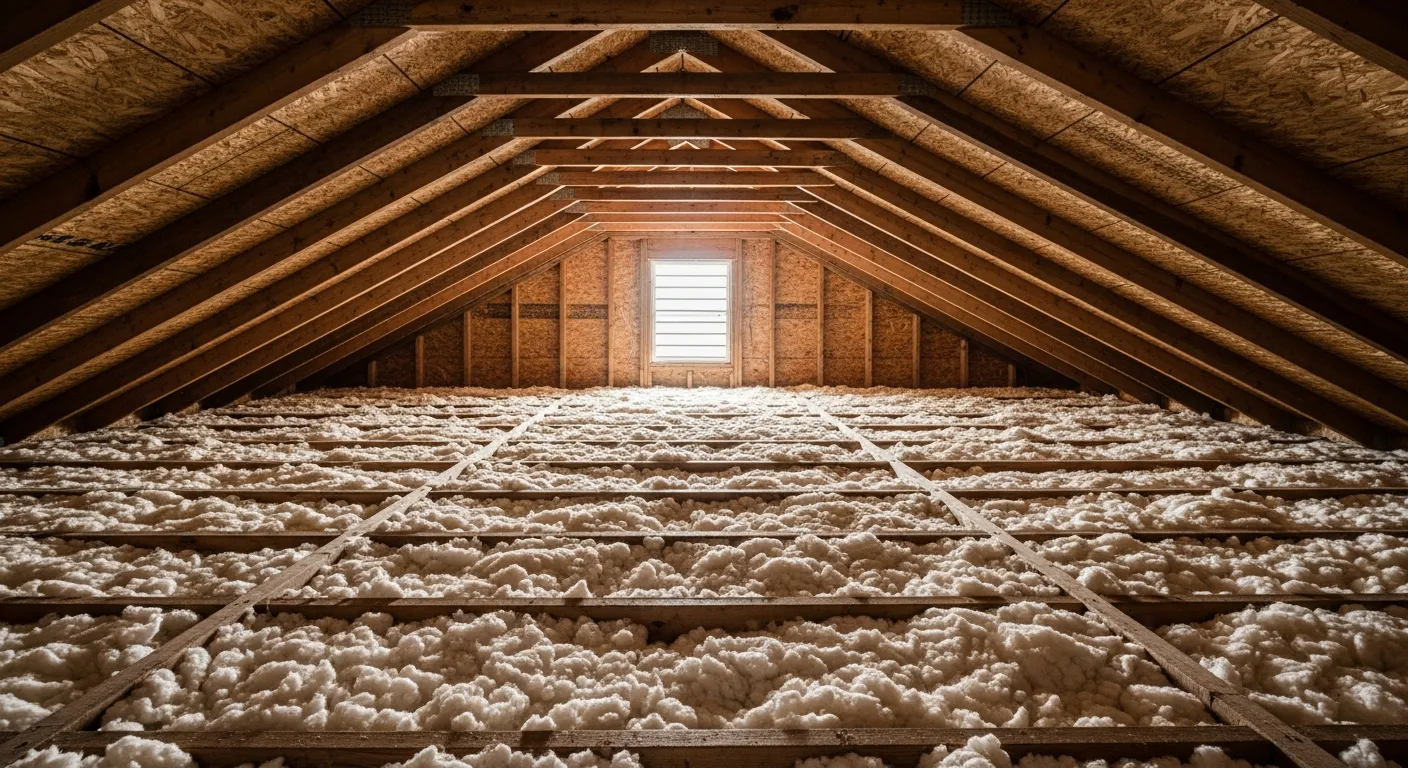
Take a flashlight and a tape measure into the attic. Measure insulation depth at multiple spots — older homes often have huge variations.
| Insulation Type | R per inch |
|---|---|
| Loose-fill fiberglass | ~2.5 |
| Loose-fill cellulose | ~3.5 |
| Fiberglass batts | ~3.2 |
| Open-cell spray foam | ~3.7 |
| Closed-cell spray foam | ~6.5 |
| Rigid foam board | ~5 |
So 8 inches of loose-fill fiberglass = R-20. To reach R-49 you'd need to add another ~12 inches.
The right order: air-seal first, insulate second
This is the single most-skipped step that quietly tanks insulation effectiveness. Insulation slows heat conduction; air sealing stops heat convection. Without air sealing, warm air pushes right past insulation through every gap, hole, and penetration in your ceiling.
A proper air sealing job seals:
- Top plates of every interior wall
- Plumbing, electrical, and chimney penetrations
- Recessed light cans (must use IC-rated AT cans or sealed retrofit kits)
- The attic hatch or pull-down stair (huge leak point — needs a weatherstripped insulated cover)
- Bath fans and ducts vented through the attic
- Knee walls and dropped ceilings
Insulation type comparison
Loose-fill cellulose (most common upgrade)
- Cost: $1.00–$2.00/sq ft installed
- Pros: High R-per-inch, blown in to fill cracks, made from recycled paper, treated for fire/insects
- Cons: Can settle 10–20% over time (account for this when topping off), can absorb moisture
Loose-fill fiberglass
- Cost: $0.80–$1.80/sq ft installed
- Pros: Lightweight, doesn't settle as much as cellulose, won't burn
- Cons: Lower R per inch; loses effectiveness in extreme cold
Spray foam (open or closed cell)
- Cost: $1.50–$4.50/sq ft installed
- Pros: Air-seals and insulates in one step, highest R per inch (closed cell), excellent for irregular spaces
- Cons: Expensive, off-gassing concerns if installed poorly, locks in moisture if there's a roof leak you don't catch
Batts (DIY-friendly)
- Cost: $0.65–$1.50/sq ft (DIY); $1.50–$2.50 installed
- Pros: Cheap, accessible, can be laid over existing insulation
- Cons: Easy to install poorly (gaps, compression both kill R-value); doesn't conform to irregular spaces
Real-world cost and savings
For a typical 1,500 sq ft attic upgrading from R-19 to R-49:
- Cost: $1,800–$3,500 installed
- Annual energy savings: $300–$900
- 2026 federal tax credit: 30% up to $1,200 (Energy Efficient Home Improvement Credit)
- Net cost after credit: $1,200–$2,500
- Payback period: 1.5–4 years
Don't forget ventilation
A well-insulated attic still needs to breathe. Without proper soffit-to-ridge ventilation, you'll get:
- Ice dams in winter
- Mold and rot in roof decking
- Premature shingle failure (heat-trapped attics cook the underside of the roof)
- Voided roofing manufacturer warranties
A pro will install baffles at the eaves so insulation doesn't block soffit vents. Skip this and the new insulation creates new problems.
Other places worth insulating
- Rim joists in basements and crawlspaces — huge cold-air leak point. Spray foam at $300–$800 pays back in a single winter.
- Knee walls and bonus rooms over garages — chronically cold. Often missed entirely.
- Crawlspace — sealing and insulating a vented crawlspace can transform a drafty floor.
- Garage ceilings below conditioned space — code requires it; older homes often don't have it.
Common mistakes
- Insulating around recessed lights instead of replacing with IC-rated AT cans (fire hazard)
- Compressing batts to "fit" — destroys R-value
- Covering soffit vents
- Skipping the attic hatch insulation cover (15% of attic heat loss escapes here in many homes)
- Not air sealing first
The bottom line
Attic insulation is the boring upgrade nobody Instagrams — and it returns more dollar-for-dollar than almost any project on this site. With current federal tax credits, payback is often under two years. Get matched with a vetted local insulation contractor for a free assessment.
Sources & further reading
- DOE — Recommended Home Insulation R-Values — the climate-zone R-value targets used as the basis for this guide.
- ENERGY STAR — Seal & Insulate — air-sealing checklist that should accompany any insulation upgrade.
- IRS — Energy Efficient Home Improvement Credit (25C) — federal tax credit covering up to 30% of insulation material costs.
- DOE — Weatherization Assistance Program — income-eligible homeowners may qualify for free attic insulation and air sealing.
Frequently asked questions
DOE recommends R-49 to R-60 in cold climates (zones 5–8), R-38 to R-60 in mixed climates (zone 4), and R-30 to R-49 in hot climates (zones 1–3).
For a typical 1,500 sq ft attic upgrading from R-19 to R-49, expect $1,800–$3,500 installed. The 30% federal tax credit (Section 25C) brings net cost to roughly $1,200–$2,500.
Always. Insulation slows heat conduction; air sealing stops heat convection. Without air sealing, warm air pushes right past the insulation through gaps and penetrations, and the new insulation underperforms.