












Foundation Problems: 9 Warning Signs You Shouldn't Ignore
A small foundation crack today can become a five-figure repair next year. Here are the warning signs every homeowner should know.
Why foundations fail in the first place
Almost all foundation problems trace back to water and soil movement:
- Expansive clay soils swell when wet, shrink when dry, and pull on foundation walls
- Poor drainage saturates soil against the foundation
- Tree roots draw moisture and create soil voids
- Plumbing leaks erode soil under the slab
- Improper grading lets water pool against walls
Most foundation repairs are downstream of unfixed drainage problems. Address drainage too, or you'll be repairing the foundation again.
1. Diagonal cracks above doors and windows
Hairline vertical cracks in drywall = normal settlement, usually cosmetic. Diagonal cracks running from the corners of doors and windows are foundation movement. The longer and wider, the more urgent. If you can fit a nickel in the crack, get a structural engineer.
2. Sticking doors and windows
Doors that suddenly won't close, latch properly, or swing on their own indicate the frame has shifted out of square. Windows that stick or won't lock are the same story. Spread across multiple rooms = foundation movement, not the door.
3. Visible cracks in foundation walls
| Crack Type | Severity |
|---|---|
| Hairline vertical (under 1/16") | Cosmetic — monitor |
| Vertical 1/16" to 1/4" | Watch closely; seal with epoxy |
| Horizontal cracks | Serious — soil pressure on wall |
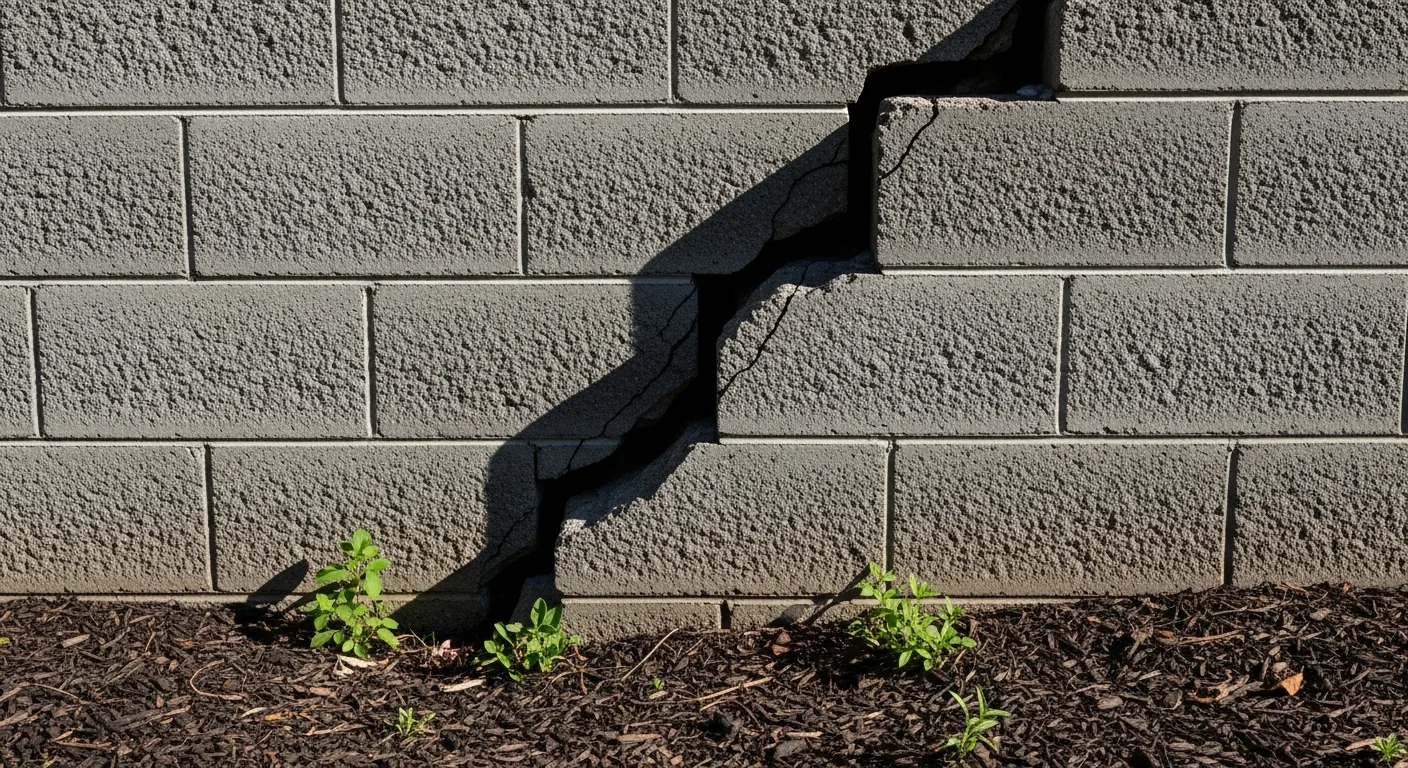
| Stair-step cracks in block | Serious — settling on one side |
| Cracks wider than 1/4" | Get a structural engineer |
| Cracks where one side is offset from the other | Active movement — urgent |
4. Sloping or uneven floors
Place a marble or golf ball on the floor in different rooms. If it consistently rolls one direction, you have differential settlement. A few rules:
- 1/2 inch slope across a room = noticeable, monitor
- 1+ inch slope across a room = engineering inspection warranted
- Sudden onset (sloping that wasn't there last year) = urgent
Use a 4-foot level on the floor to confirm. Older homes often have minor settlement that's not getting worse — context matters.
5. Gaps where walls meet ceilings or floors
Triangular gaps appearing between the wall and the ceiling, or between baseboards and the floor, indicate the wall (or floor) has dropped. If you can see daylight or insulation through the gap, this is structural — not a paint job.
6. Cracks in tile, brick, or chimneys
- Tile cracks running across multiple tiles in a straight line = floor movement underneath
- Brick stair-step cracks on exterior walls = differential settlement
- Chimney pulling away from house = footing failure (a leaning chimney is a serious safety issue)
7. Bowing or leaning basement/crawlspace walls
Hold a long straight edge against your basement wall. Any visible bow inward indicates soil pressure (hydrostatic pressure from saturated soil). Bowing walls can fail catastrophically — once movement starts, it accelerates. Repair options range from carbon-fiber reinforcement ($600–$1,000 per strap) to wall anchors and helical tiebacks ($800–$3,000 per anchor).
8. Water in the basement or crawlspace
Even if the water itself is the immediate problem, persistent moisture is a red flag for the foundation:
- Saturates and weakens the soil bearing your footings
- Causes rebar/wire mesh to rust and expand, cracking concrete
- Leads to mold and wood rot in framing
- Can indicate failed drain tile or inadequate site drainage
9. Gaps around exterior doors, windows, or trim
Walk the exterior of your house. Look at:
- The seal between trim and siding (gaps that weren't there before)
- Caulk lines that have torn open
- Any visible separation between the chimney and the house
- Garage door openings — does the door still seat squarely against the floor?
How to monitor a crack you're not sure about
- Mark each end of the crack with a pencil and date it
- Measure the width with a feeler gauge or a ruler with a fine scale
- Take a photo with a coin or scale next to it
- Re-measure every 3 months
- If the crack grows in length or width, get a pro inspection
Small monitoring tip: crack monitors ($10–$15) are clear plastic gauges that mount across the crack and show movement to the millimeter.
Repair options and 2026 cost ranges
| Repair | Best For | Cost |
|---|---|---|
| Epoxy/polyurethane crack injection | Non-structural cracks | $300–$800 per crack |
| Carbon fiber straps | Bowing walls (early stage) | $600–$1,200 per strap |
| Wall anchors / helical tiebacks | Bowing walls (active) | $700–$2,500 per anchor |
| Concrete piers | Settling on one side | $1,200–$3,000 per pier |
| Helical / push piers | Significant settling | $1,500–$3,500 per pier |
| Slabjacking / mudjacking | Settled slab or sidewalk | $3–$25 per sq ft |
| Polyurethane foam injection | Settled slab (modern alternative) | $5–$30 per sq ft |
| Full underpinning | Severe settlement | $15,000–$45,000+ |
Prevention: protecting the foundation you have
- Keep gutters clean and downspouts extended at least 4 feet from the house
- Maintain positive grade (6 inches drop over 10 feet) away from foundation walls
- Don't plant large trees within 20 feet of the foundation
- Water foundation soil during droughts to prevent extreme shrinkage (in clay soil regions)
- Fix plumbing leaks immediately — slow leaks under slabs cause major damage
- Install or maintain a French drain or interior perimeter drain in wet basements
Get a structural engineer (not just a foundation company)
Foundation repair companies sell repairs. A licensed structural engineer works for you — they assess the problem, recommend a solution, and don't profit from the repair itself. Their report ($400–$1,200) tells you what's actually needed and lets you get apples-to-apples bids from repair companies.
Big red flag: any foundation company that won't let you get an independent engineer's opinion before signing.
The bottom line
Foundation issues never fix themselves and almost always get worse. If you're seeing 2 or 3 of the signs above — especially diagonal cracks above doors, sloping floors, or bowing basement walls — get an inspection now. Get matched with vetted local foundation pros for a free assessment, and consider a separate engineer's evaluation before committing to expensive repairs.
Sources & further reading
- InterNACHI — International Association of Certified Home Inspectors — inspector standards of practice covering foundations, settlement, and structural defects.
- ASCE — American Society of Civil Engineers — the professional body whose licensed PEs sign off on structural foundation repairs.
- FEMA — federal guidance on foundation performance in flood, seismic, and high-wind events.
- IBHS — Insurance Institute for Business & Home Safety — research-backed guidance on foundation drainage and water intrusion.
Frequently asked questions
Diagonal cracks above doors and windows, doors and windows that suddenly stick, sloping floors, gaps where walls meet ceilings or floors, and stair-step cracks in brick or block are the most common early warning signs.
Hairline vertical cracks are usually cosmetic. Horizontal cracks, stair-step cracks, cracks wider than 1/4 inch, and any crack where one side is offset from the other are serious and warrant a structural engineer evaluation.
Crack injection runs $300–$800 per crack; carbon-fiber straps $600–$1,200 each; piers $1,200–$3,500 per pier; full underpinning $15,000–$45,000+. Always get a licensed structural engineer report before signing any repair contract.